


Having control over progress and expected costs is fundamental for a professional project manager. There are many ways to gather this kind of progress information, but the requirement is usually that the data is quantitative, verifiable, and non-reversible.
The most well-known method is "Earned Value" (EV), a simple and powerful method that requires little information to tell you a lot about the project's status. EV has a bit of a tough reputation – not because it's complex, but because you need a proper schedule in place. Unfortunately, most people stop at saying where they are, and forget to mention where they should be.
To make this happen, the project manager has to take on the role of a planner, and unfortunately, activity lists in Excel just won't cut it. You'll need MS Project or a similar tool here. The illustration below shows the connection a project manager should be able to present:
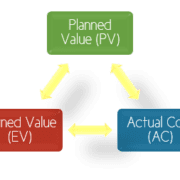
Unfortunately, many project managers don't fully use the opportunities EV offers because the customer doesn't know the method and therefore doesn't ask for it. As an expert, it's the project manager's job to share these insights with the customer, ensuring the customer always has the best possible basis for making decisions that steer the project in the right direction.
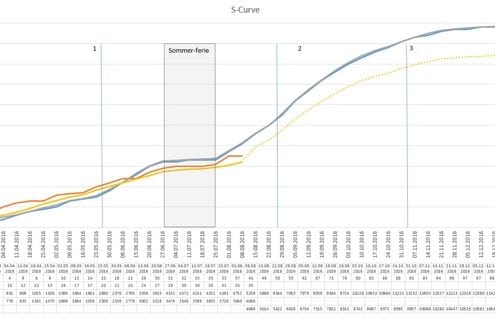
Additionally, it's a good idea to present EV over time as an S-curve:
- S-curves are primarily a visual management tool for the steering committee, making it easy to ask the project manager the right questions and spot trends without having to read through endless reports.
- Project managers use S-curves to communicate status and quality, and to secure their own schedule early in the project.
To provide maximum clarity, Progress and Time Spent should be presented on separate axes:
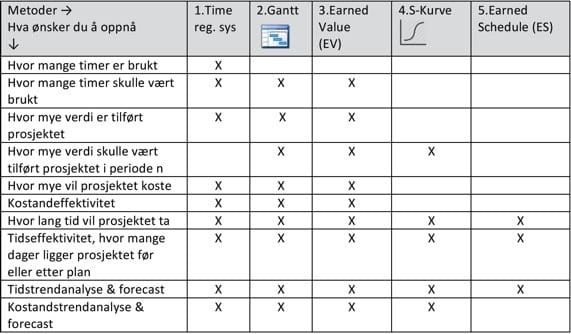
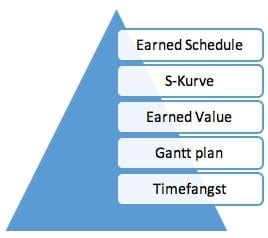
A project manager must always have a clear idea of the scope of their delivery and the questions they want answered. Each of these requires different data and methods. For example, you can't create an S-curve without a proper schedule in place, and you can't calculate an "Earned Schedule" without an S-curve as your methodological foundation:
In other words, as a project manager, you work according to a clear information pyramid:
The biggest sin for a project manager is reporting the wrong status to the PMO or steering committee due to a lack of familiarity with the subject. Unfortunately, we often see project managers reporting EV values (like EAC) without having a schedule to back it up. A classic mistake is reporting status based only on what you do know (such as time spent and total budget). As a result, project managers often report progress not as value added to the project, but simply as how much of the budget has been used.
Why isn't Earned Value enough?
EV consists of a whole range of indicators and indices that professional project managers use when planning and communicating with the PMO and steering committee, but it's not foolproof:
- SPI (Schedule Performance Index) will always end up at 1.0 by the end of the project, making it pretty useless as an index once the project is 50% done.
- SV (Schedule Variance) will always hit 0 by the end of the project. This isn't a great indicator to steer by when facing major delays either.
In other words, Earned Value doesn't tell you anything about TIME, only COSTS. "Earned Schedule" (ES) doesn't replace EV, but is designed to give you the full picture together with EV:
- «Earned Schedule» tells you something about the value of the deviation from planned progress in number of days or periods called ES, and is expressed in the reporting period the project is in according to current progress. If planned ES = 16 (current reporting period) and actual ES = 15.4, you are 3 days behind schedule.
- «Earned Schedule» gir en reell SPI index, som kalles SPI(t). 1 = på plan, >1 = bra, <1 = ikke bra
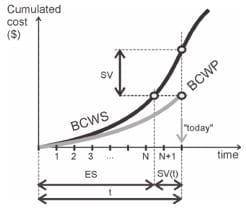
Unfortunately, it is not the lack of a proper template or description of a method that is the main challenge, but the understanding of the method. An enlightened steering group that has a sense of control is a satisfied steering group. This gives an even more satisfied project manager who can use the time for what really adds value: to steer the project in the direction that provides the greatest value for the customer.
Solutions in MS-Project
The practicality of using MS-Project as a basis for solving the problem is that all answers and analyses are already there. The only thing that needs to be done is to extract the information you need.
You can go to great lengths to start with the formulas in the link at the bottom of the article and build a solution to this. Or you can use an existing MS-Project template (free) and get training on how to use and further develop it to meet YOUR needs and make you better in your organization. Save time and money by getting in touch.
More information: http://easyrisk.eu/from_earned_value.asp